Game-Score Series consists so far of following compositions:
• Lost Dungeons, Forbidden Woods (for Keyboards and Electronics ad lib.)
• Paratopic (for e-guitar)
• Mild Weather Expected (for Electronics ad lib.)
Interactive Game-Scores
• An ongoing series of digital scores created in with Unit game engine
• Premiered at the Imaginal Machines Festival Hannover, 2024
• A subject of an ongoing research project
PARATOPIC (2024)
(for e-guitar and fx pedals ad lib)
Inspired by groundbreaking contemporary thinkers in media theory—such as Ian Bogost, Alexander R. Galloway, and McKenzie Wark, who work at the intersection of digital media, game studies, and xenocommunication—I began to ask myself some years ago what new forms a musical score might take.
Traditional musical notation could be seen as an example of radical resistance to the technological developments of the last hundred years. The gap between conventional notation and the sonic parameters it represents on the one hand, and modern musical practices on the other, can hardly be overstated. The communicative model underlying the traditional score is no longer adequate for most of the forms contemporary musical practice can take. Due to its limited bandwidth and one-directional signal flow, it becomes rather an obstacle for imagining new forms of musical expression. What I was trying to imagine, was rather based on digital, non-linear flow of communication and open for participatory processes and feedback loops.
Having worked with game engines for several years, I wanted to attempt using them in compositional practice—specifically, to develop a new form of interactive musical notation. I was interested in a notation system that, by virtue of its digital nature, could be defined by interactivity and non-linearity. Instead of a conventional page, I wanted to propose a notation-space (including procedurally generated elements). Gamification of interpretative processes should play an important role: rather than linear pathways, digital musical notation would function as three-dimensional diagrams of possible interactions.
In this, I am guided by research in ludomusicology and take inspiration from the tradition of experimental exploration games (also known as walking simulators). Titles such as Proteus, Pattern, Panoramical, The Shape of the World, and others can certainly be seen as interactive audiovisual artworks that unfold through individual exploration. Strictly speaking, these are not games in the conventional sense, but open environments in which interaction is limited to one’s presence in the virtual world, as well as to modes of navigation and perception. To this principle, I wanted to add an additional layer: a set of rules—defined individually for each composition—governing sonic interpretation.
PARATOPIC - Interactive Game-Score
Premiered by Seth Josel
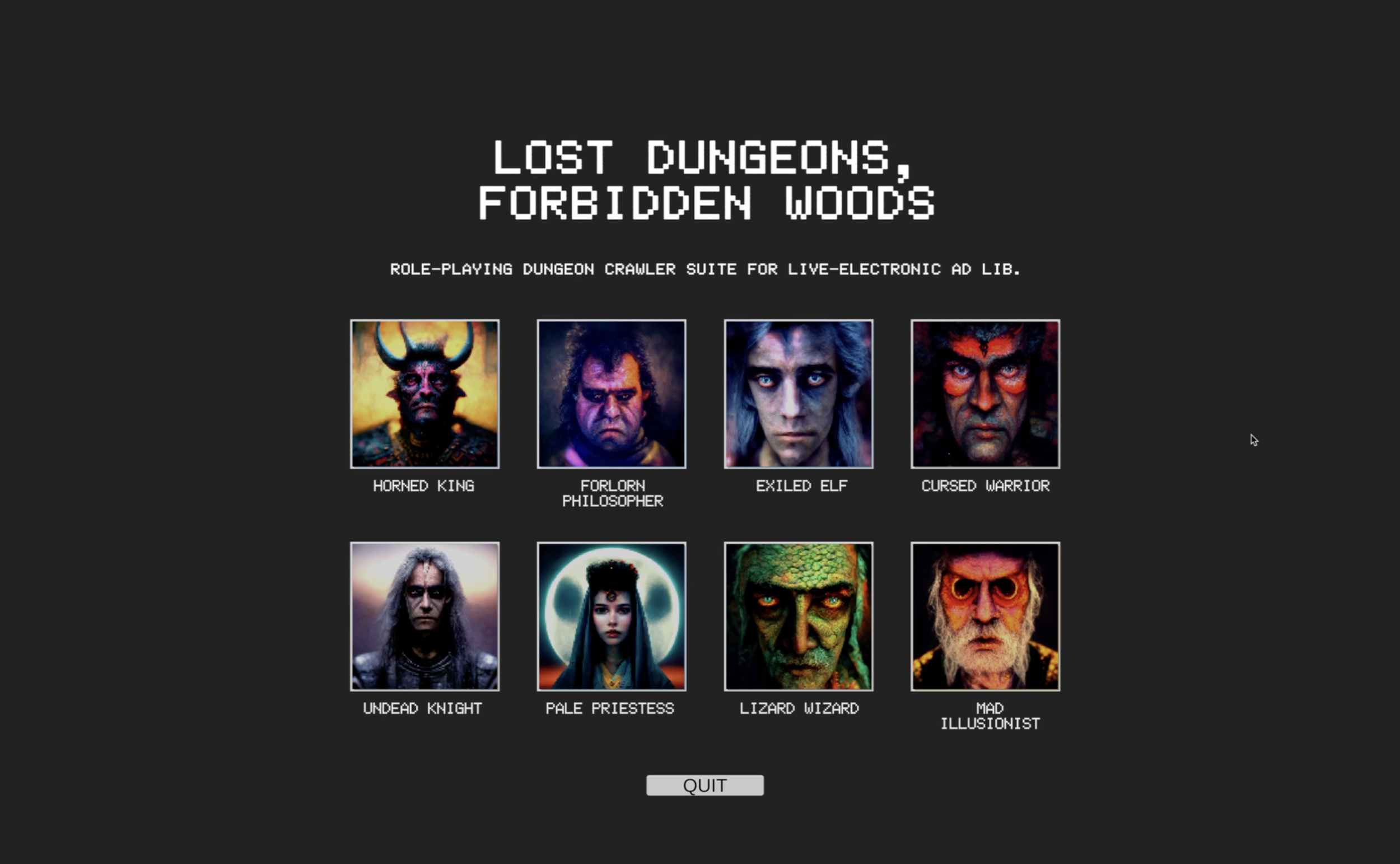
• "horned king"
• "forlorn philosopher"
• "exiled elf"
• "cursed warrior"
• "undead knight”
• "pale priestess"
• "lizard wizard"
• "mad illusionist"
Lost Dungeons, Forbidden Woods (2022-23)
ROLE PLAYING DUNGEON CRAWLER SUITE FOR LIVE-ELECTRONIC SETUP AD LIB.
Lost Dungeons, Forbidden Woods is my first composition created entirely within the Unity game engine. Eight characters anchor the structure, each requiring the performer to “play” them through a personal constellation of electronic instruments. Drawing on the aesthetics of early CRPGs, the piece turns the dungeon crawler into an abstract musical map, open to detours, backtracking, and unexpected routes. Performance becomes exploration—an encounter with form through movement. The result is a hybrid form in which game logic becomes a structural device for musical interpretation.