#AI
#complicity
#artificial time production
#object ontology
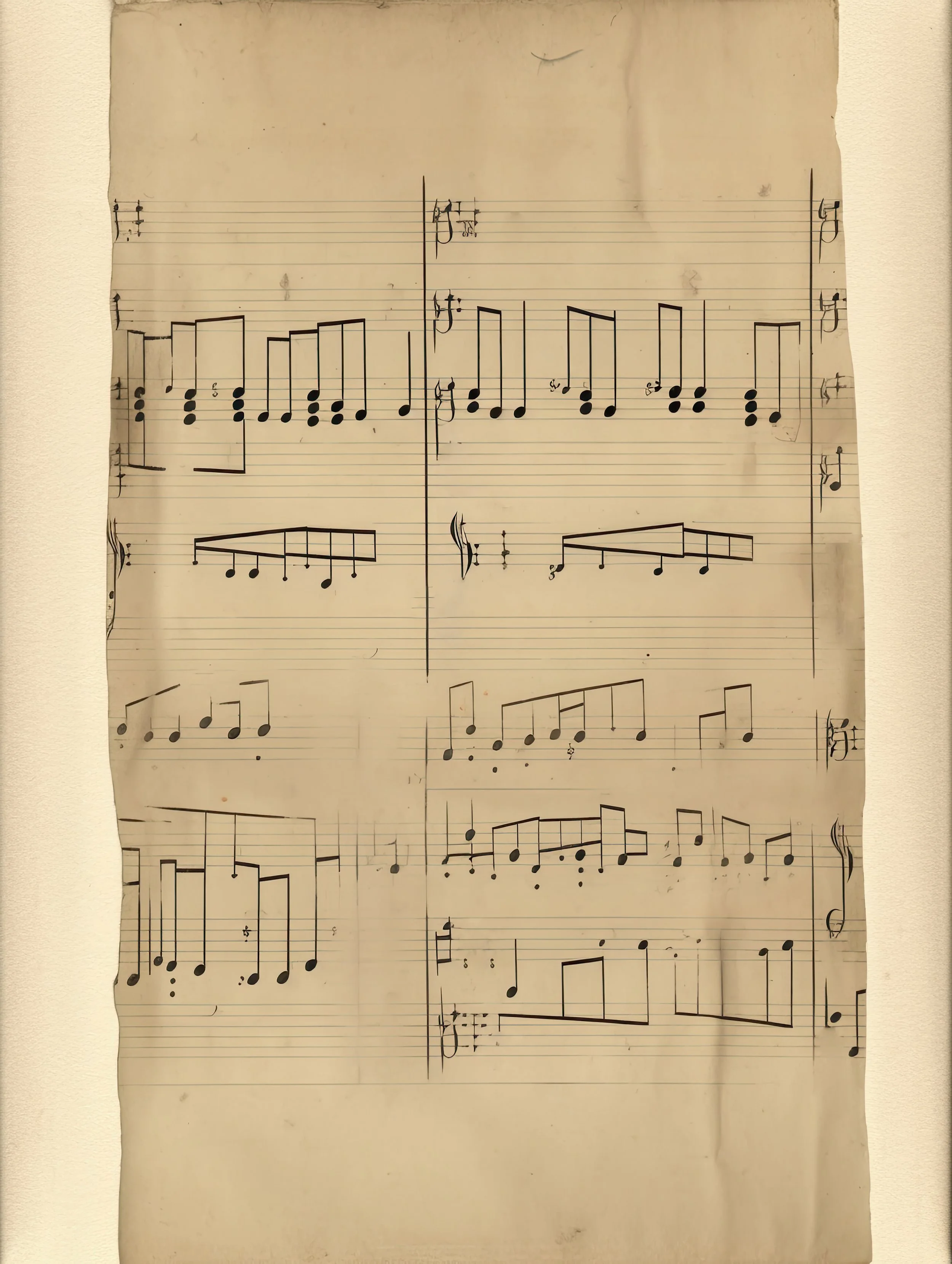
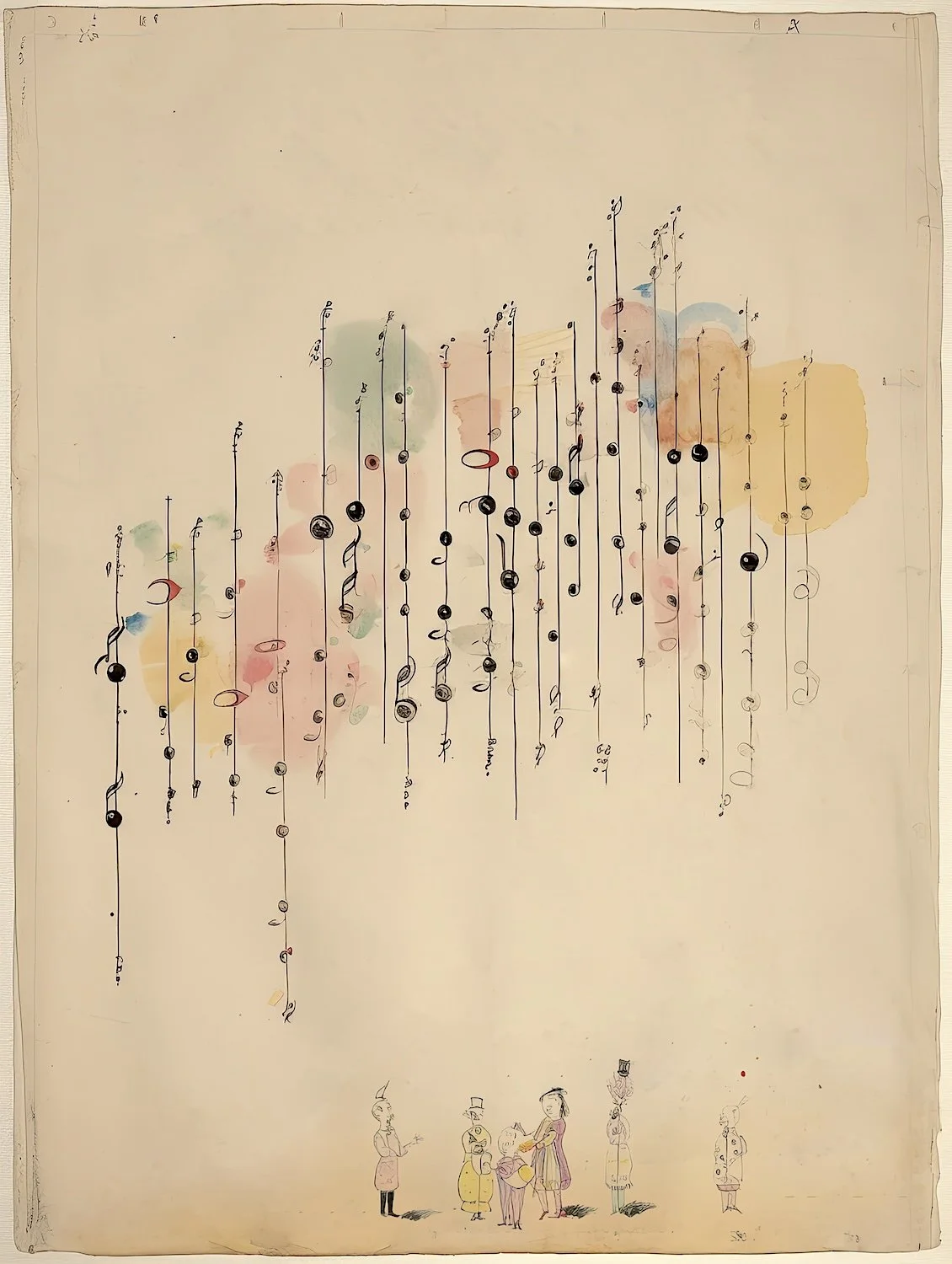
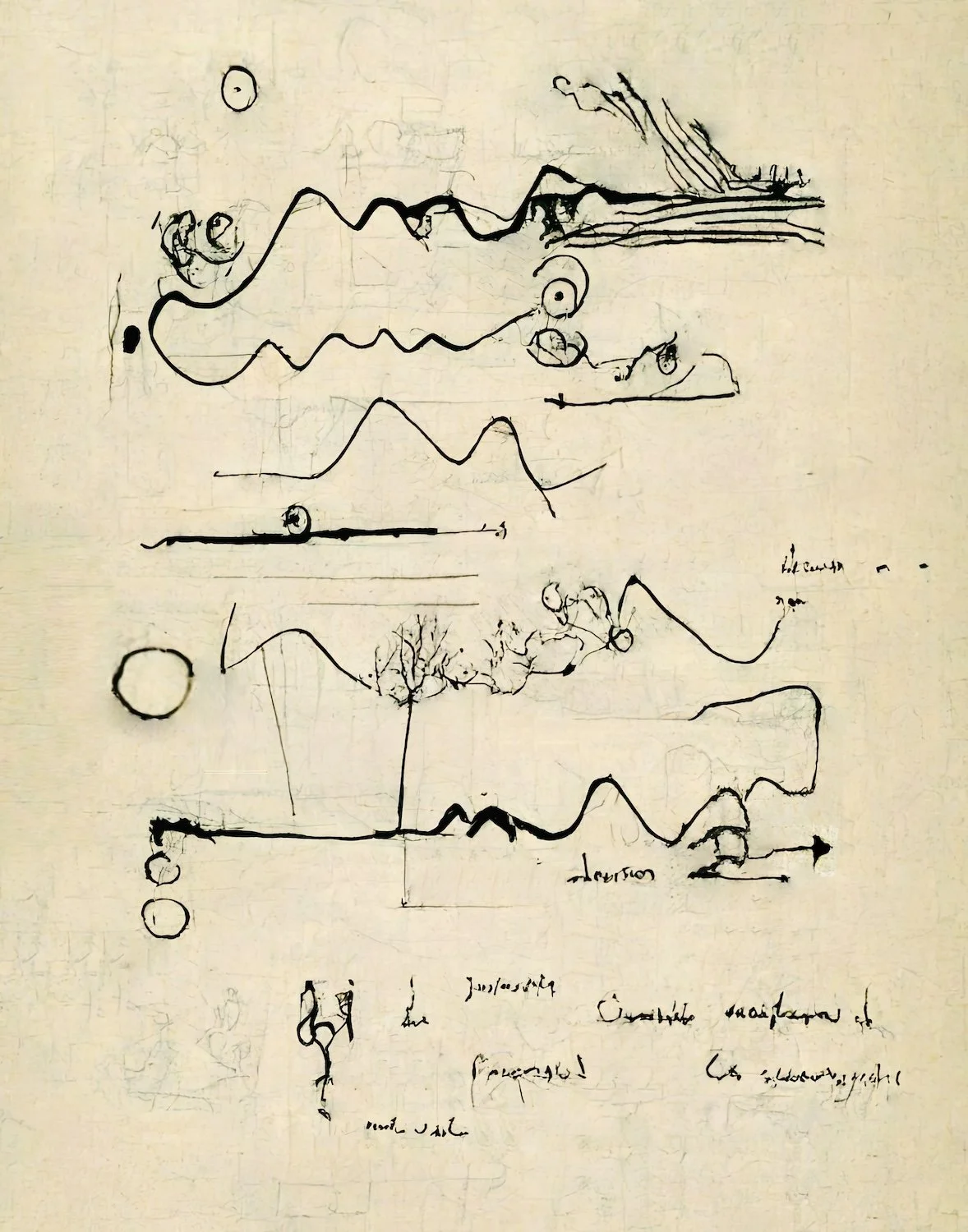
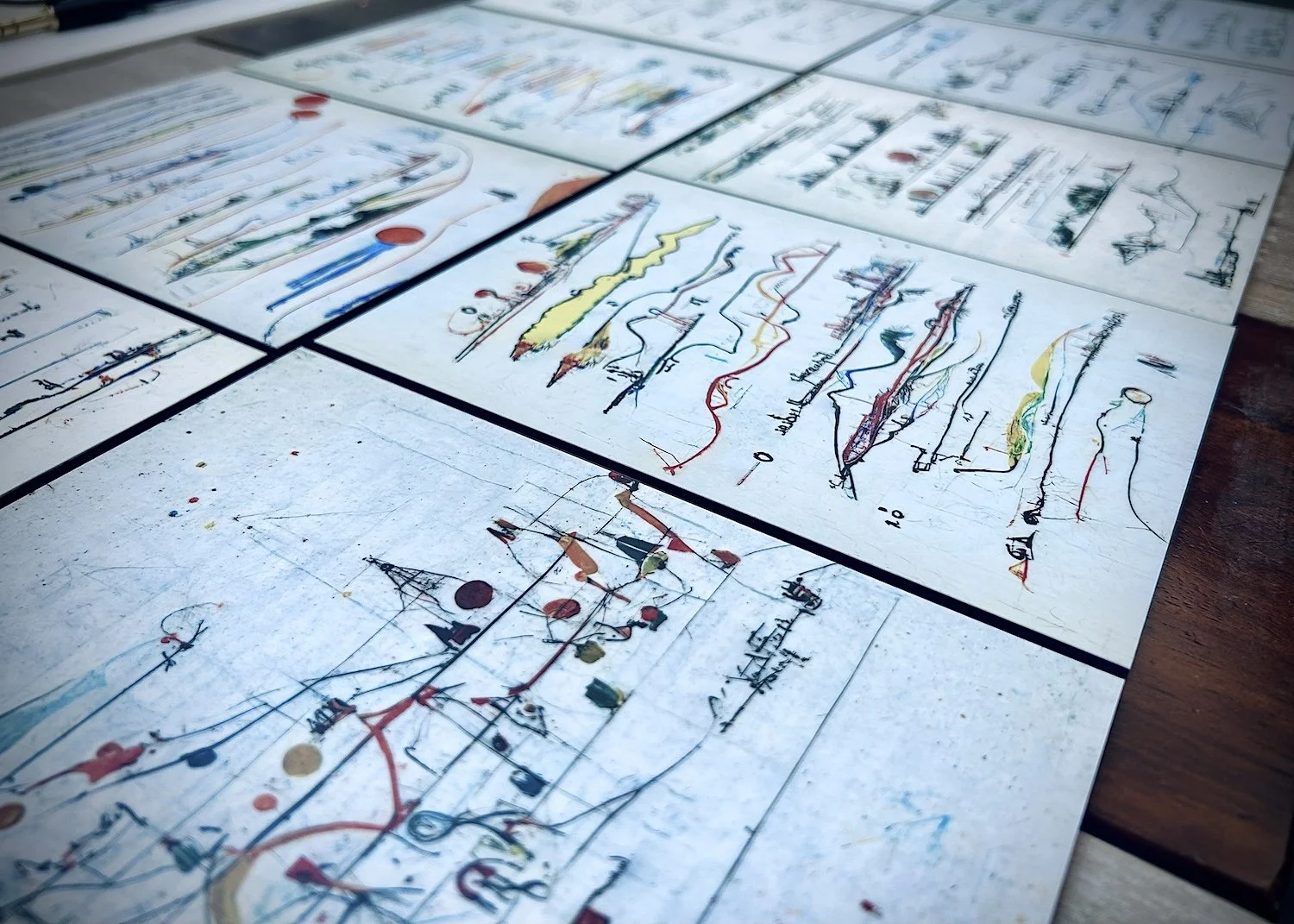
Executable Notations:
Complicity with Artificial Imagination
-> You can find further examples and individual works related to this project on the following page.
01. Complicity
Since 2022, I have been developing a series of graphic scores aimed at exploring non-trivial forms of collaboration with AI systems. The central concept guiding this project is complicity. The term derives from cum plectere—to be tightly interwoven. Its origin lies in criminal law, where it typically carries negative associations. The cultural theorist Gesa Ziemer, however, reframes complicity as a productive mode of working, particularly relevant to emerging forms of artistic authorship.
In legitimate collective actions, complicity is marked by temporary alliances: shared yet individual; inventive yet goal-oriented. Complicity implies co-agency: one conceives an idea, forms a plan, and realizes it together. These are also the three stages through which complicity is defined in legal terms.
Why invoke this term here? To answer this, we must take a brief detour through object-oriented ontologies.
02. Objects and Tools
A central concern of twentieth-century philosophy was the recognition of the autonomy of non-human actors—more simply, objects. The trajectory begins with Husserl’s phenomenological call to return “to the things themselves.” Heidegger follows with his analysis of tools; decades later, Graham Harman develops Object-Oriented Ontology, while Levi Bryant and Timothy Morton independently elaborate object-based ontologies such as Onticology and The Democracy of Objects. Bruno Latour’s work is decisive in this context—most notably his proposal of a Parliament of Things, in which objects participate alongside subjects.
Jean-Marie Schaeffer’s claim regarding the “end of human exceptionalism” acknowledges that objects exercise a determining influence on subjects. Objects are active participants that reveal themselves through a paradox: they enable while simultaneously obstruct; they allow us to realize our intentions, but only on their terms, often diverting the process in unforeseen directions. Rather than submitting to subjective command, objects profoundly shape artistic work and co-produce its outcomes.
From this perspective, every artwork—and every musical composition—can be understood as the result of collaboration with non-human agents. Or, put differently, as a trace, a memory, a report of an encounter between heterogeneous ontological orders.
Returning to the three stages of complicity (idea, planning, realization): at which point does this encounter occur? In most creative processes, the dialogue between subject and object becomes apparent only during the final phase—the realization of the idea, when chosen tools begin to interfere with or redirect intention. Here, AI differs significantly from conventional tools. Unlike most instruments, AI can participate from the outset, across all three stages of complicity. For this reason, I understand the abbreviation AI not as Artificial Intelligence, but as Artificial Imagination.
AI enables engagement even before an idea has taken shape. It offers a space for shared speculation, for the exploration of unformed possibilities—for interwoven dreaming.
Is this kind of creative complicity new within the history of art? I would argue that such processes have always been examined through and as art—perhaps this is precisely what art is. Every artwork could be understood as the trace or structured reminiscence of an encounter with an alien ontological order. Consider, for example, the ancient Greek Muses or the chance operations of twentieth-century art—they manifest the same principle. The difference is that AI allows for a conscious, traceable, and communicable engagement at the threshold of an alien imagination.
03. Graphic Scores and Artificial Time Production
Although this series of compositions draws on the tradition of graphic scores (1950s: Earle Brown, John Cage, Cornelius Cardew), my primary interest lies in using AI to summon a new, third form of musical notation—one that mediates not epistemologically, but ontologically. A notation that does not first prompt the question “WHAT does this mean?” but rather “WHERE am I?”
The visual language I’m after is at once concrete and entirely unreadable—at least as long as it is approached as an object belonging to our familiar temporal order. It has often been said that music can be understood as structured time. If this is the case, then Nick Land becomes relevant here: he links AI with the artificial production of time and the emergence of parallel temporal processes.
“As soon as you get artificial time production, there can be no more consensus about what time we are in, at all.”
And further: “It is not that technology happens in time, but that time happens in and through technology.”
In this sense, the scores in this series can be viewed as musical articulations of anomalous temporalities. Confusion, disorientation, and synchrony function here as artistic strategies, enabling an exploration of foreign temporal orders. The works attempt to render a specific form of mediation perceptible—one whose primary message is the act of mediation itself.